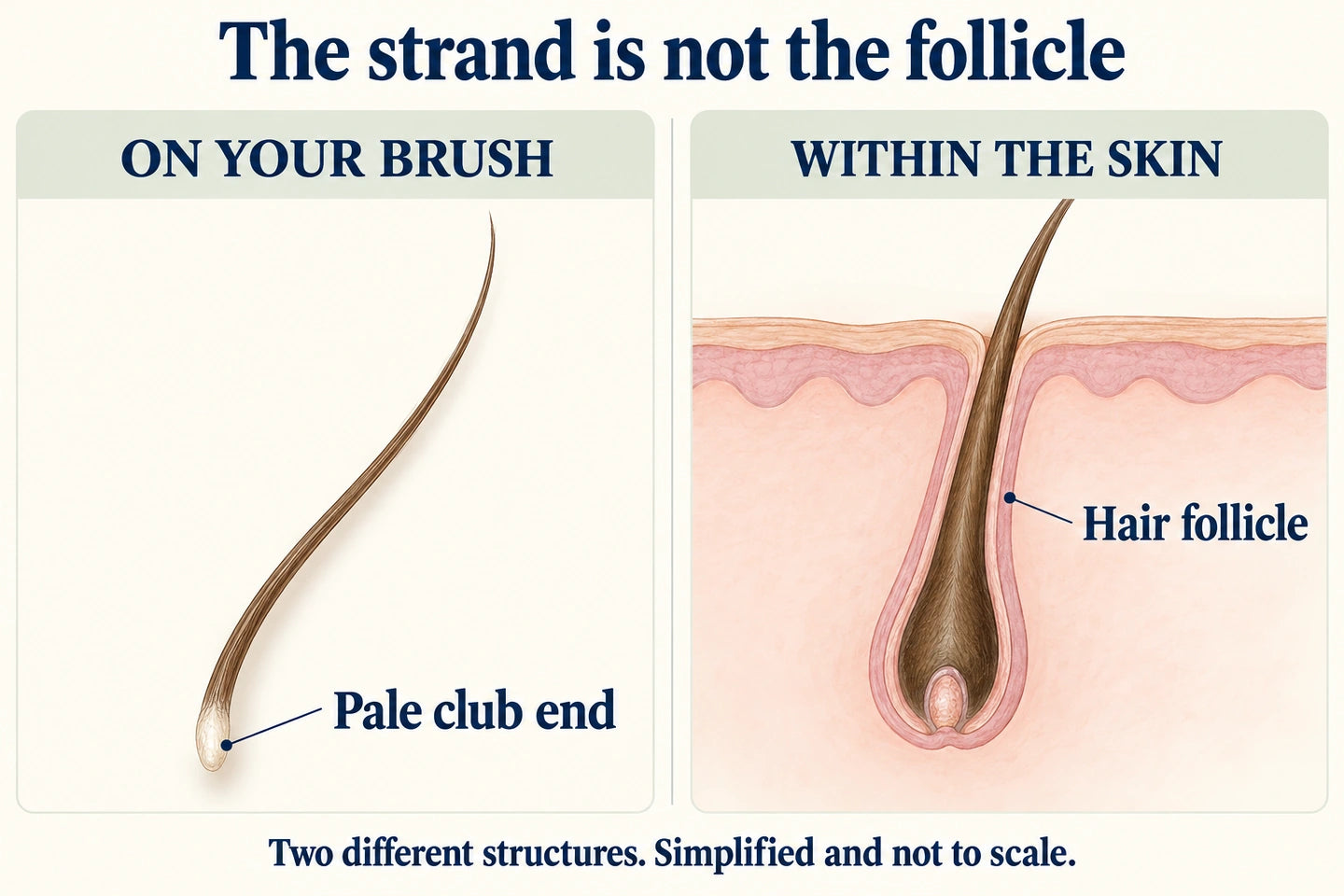
You find a hair on your sleeve and turn it toward the light. One end has a tiny pale club. The immediate worry is often much bigger than the object: have I lost the part that makes the hair grow? The pale end of a naturally shed resting hair belongs to that hair; the follicle is a structure within your skin. Picking up a club hair is different from removing a whole follicle.
That distinction lets you put the strand down and return to the part of hair care you can use today. A comfortable wash, gentler detangling and a scalp product chosen for a clear purpose all deserve more attention than repeatedly inspecting the same pale end. Start by understanding what you found, then give your scalp and lengths the care they need.
The club end, the root and the follicle are different things
The hair shaft is the strand that forms your hairstyle. Its root is the portion associated with the follicle beneath the skin; a shed resting hair can have a pale, club-shaped root end. The follicle is the surrounding structure in the skin where hair develops. It is not the tiny object resting on your sleeve.
DermNet describes resting hairs as club hairs because of that end shape. Hair growth follows a cycle, and a new growing hair can develop as the older resting hair is released. Finding a club-ended strand fits a familiar part of that cycle.
There is another reason the word bulb can be confusing. The living hair bulb at the base of a follicle, where the growing shaft is produced, is different from the pale club end on a shed resting hair. Calling both a bulb can make an ordinary finding sound like the whole growing structure has come away.
Use the distinction to answer the immediate worry. You have found a strand with a particular end. Whether shedding has changed across your scalp is a separate question, best understood from the overall course rather than the size or shade of one tiny club.
Is the frustration shedding, snapping or both?
A long hair on a brush and a short piece caught in a tangle can lead to the same anxious search, but they point toward different practical concerns. A club-ended strand helps you recognize a resting hair that has shed. Short pieces appearing during snagging or after damaging services raise a question about breakage through the lengths.
Length alone is not a diagnosis: short hairs can also be growing hairs. Look at the experience around them. Does the comb catch in the same knot? Do the ends feel rough after bleaching? Has the amount of full-length hair coming away changed over several familiar washes? These questions tell you where attention would be useful without turning the bathroom into a microscope session.
| What is happening during grooming? | Where to put attention |
|---|---|
| An occasional club-ended hair appears during a familiar wash | Continue suitable cleansing and gentle handling |
| Full-length shedding has become persistently different | Discuss the overall change and any visible thinning |
| Hair repeatedly catches and snaps through the lengths | Improve detangling, conditioning and handling |
| A new patch, pain or ongoing scalp irritation appears | Arrange a scalp assessment |
You can have more than one concern. Address the knot where it happens, care for the scalp according to its condition and give a sustained change in coverage its own explanation.
Make the next wash feel easier
An alarming shower collection can make you hesitant to touch the roots. Give the wash a simple purpose: remove the oil and styling residue that have accumulated, then rinse thoroughly. Focus shampoo at the scalp instead of bunching the lengths into a rough lather. Let wash frequency follow your hair type and how dirty or oily the scalp becomes.
A longer gap between washes can bring more loose hairs into one grooming session. Think about the interval before comparing that collection with a wash the next day. The presence of those hairs does not change where the cleanser belongs or create a reason to scrub the scalp harder.
If fine hair and oily, coated roots are your practical concern, Folivis RESET Hair Thickening Shampoo gives wash day a clear job. Its rinse-off formula, including niacinamide and panthenol, is intended to remove excess oil, buildup and daily residue. Choose it because you want effective cleansing at the roots and a wash that fits your scalp-care routine.
Use RESET on wet hair and scalp, massage gently and rinse thoroughly, repeating if needed according to the label. Finish with length care suited to your hair. Choose cleansing that gives the roots a fresh, comfortable starting point for your usual style.
Release the tangle instead of pulling through it
When the problem is a knot, make the comb's journey shorter. Work in a manageable section, begin near the ends and gradually move upward as resistance releases. Conditioner can provide slip; where you apply it depends on your texture and needs. Fine, straight hair may need it mainly toward the ends, while dry or curly lengths may need broader application.
Choose detangling conditions that suit the hair. Dermatology guidance recommends a wide-tooth comb for wet detangling; thick, curly hair can be combed with conditioner in the shower, while straight hair can be allowed to dry a little first. Support the section above a difficult knot rather than dragging from the scalp through the full length.
After rinsing, absorb moisture gently with a towel or T-shirt. Treat a snag at the nape, an abrasive accessory or repeatedly bleached ends as a specific styling problem worth adjusting. A stylist can help you choose a manageable shape and a gentler approach to your next service. Everyday care becomes less frustrating when the tool stops fighting the same section.
Give daily scalp care a purpose beyond the strand you found
You may also want a regular leave-in step for the scalp, especially if your concern has moved beyond one shed hair to the feel and appearance of the roots. Folivis SUPPORT Hair Growth Serum offers a lightweight, water-based formula with three peptides, caffeine and niacinamide for a healthier-looking scalp and fuller-looking hair.
The reason to consider this format is focused care between washes. It reaches the skin beneath the hairstyle without making the lengths the destination for another product. Use it once daily on a clean, dry or towel-dried scalp, parting to distribute across the areas of concern, then massage gently and leave it in.
Choose SUPPORT when that daily scalp step is what you want to add. If coated roots are the immediate issue, start with suitable cleansing. If the lengths are snagging, improve their conditioning and handling. Build the routine around the care you want to add, with each step chosen for your scalp and hair.
Bring the wider change into focus
If full-length shedding remains unusually heavy, the part keeps widening or a patch appears, discuss that course with a clinician. A short description is enough to begin: when the change started, whether coverage has changed and any relevant illness, dietary or medicine changes. You can obtain an explanation without collecting every strand that comes away.
Keep topical care within its directions: avoid eyes, stop use for irritation and keep SUPPORT off broken or irritated skin. If prescribed scalp treatment is already part of your routine, ask the pharmacist or prescriber about coordinating another topical product. An uncomfortable scalp deserves attention alongside the hair itself.
Understand the pale end, then care for the hair you have. Choose Folivis RESET when oil and residue make the roots difficult to manage, or Folivis SUPPORT when you want focused daily scalp attention. A clear explanation and a well-chosen routine can make the next grooming moment feel much more manageable.